The Pace That Heals: A Day Walked at Human Speed
The Pace That Heals: A Day Walked at Human Speed
The best medicine cabinet I ever opened had dirt roads instead of shelves and limestone walls instead of labels.
At Villa QA, the morning begins not with alarms but with church bells—irregular, human-made rhythm that bounces off the valley walls at 6:17, then again at 6:23, as if the bellringer himself needed an extra moment to wake. I watch from the terrace as mist pools in the olive groves below, thick enough to wade through. The first hikers—a German couple in their sixties—are already lacing boots by the stone fountain, their breath visible, their conversation a murmur that doesn't disturb the quiet but adds to it.
By seven, the kitchen smells of bread and rosemary. Not the ornamental kind, but the wild rosemary that grows along the trail to Pieve Santo Stefano, branches thick as fingers, oils so potent they stain your palms green if you brush past them. Our chef uses it in the morning focaccia because she walks that path three times a week and can't help bringing it home. This is how slow walking infiltrates everything here—it changes what you cook, what you notice, what you carry back.
The Architecture of Slowness
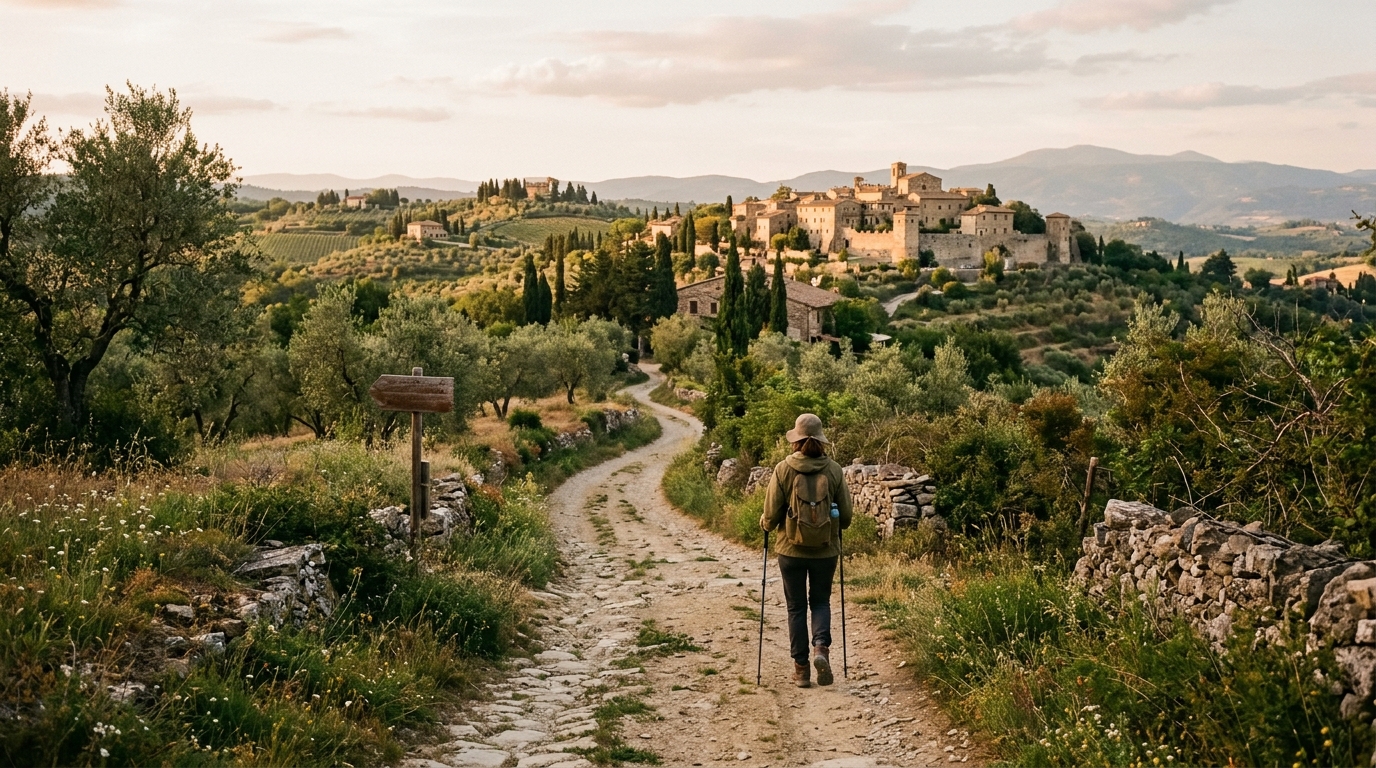
The trails around the villa weren't designed by urban planners or tourism boards. They were worn into existence by farmers, monks, shepherds—people who moved because they had to, at the speed their bodies and animals allowed. The main route to Anghiari, a medieval borgo clinging to a hilltop five kilometers east, follows a mule track that's been there since the 1400s. The gradient is gentle not out of kindness but necessity. Mules don't negotiate.
Mid-morning, I join two guests—a writer from London and a therapist from Milan—on the first hour of this walk. We say almost nothing. The path is wide enough for single file only in places, which makes conversation optional, blessedly optional. What we do instead is notice: the way sunlight enters the canopy at different angles every fifty meters. The temperature pockets—cool in the shade of oaks, warm where the path opens to wheat fields. A hand-painted shrine to Mary, flowers fresh, nestled into a stone wall that predates most nations.
The therapist stops to photograph it, but she doesn't. She just stands there, hands in pockets. Later she tells me it was the first time in months she'd looked at something without needing to capture it.
What Happens in the Body
By noon, we're in Anghiari's piazza, stone underfoot polished by centuries of soles. The borgo is a masterclass in verticality—stairs everywhere, alleys that climb and twist, doorways built for smaller humans. We sit at a cafe that serves nothing quickly. The espresso takes eight minutes. The panino takes twenty. No one apologizes.
This is where walking at three kilometers per hour does its quiet work. Your cortisol drops. Your vagal tone improves. Blood pressure evens out. But the real shift is harder to measure: you start moving through the world at the speed it was built for, before combustion engines rewrote our expectations of distance and time.
A local man—seventies, flat cap, unrushed—asks where we're from in Italian so clear even the Londoner understands. He tells us his grandfather walked to Florence once, three days, carrying wine to sell. Walked back empty-handed, singing. "Now we complain if the autostrada has traffic," he says, smiling into his wine. "We forgot our legs work."
The Afternoon Unraveling
Back at the villa by three, the heat is serious. Siesta isn't optional here—it's structural. Shutters close. Conversations lower. The villa itself seems to breathe slower. I find the writer asleep in the library, book open on her chest, boots still on, laces loosened. There's dirt on the tile from the trail. I don't clean it yet.
Four-thirty brings the second wave of walkers—shorter routes, cooler air. Some guests take the loop to the chapel, thirty minutes through oak forest where the ground is soft with centuries of leaves. Others sit. Sitting, after walking, is its own small art. Your muscles remember the work. Your mind stays clear but unpressured, like water after sediment settles.
Dinner is at eight, outside, long table under strung lights. The conversation is different after a day spent walking—less performative, more generous. People ask each other real questions. The German couple describes the monastery ruins they found off-trail. The therapist talks about her practice in Milan, the epidemic of hurry, how all her patients want pills but maybe need boots.
Someone asks if the villa organizes guided hikes. I explain we don't, not formally. We provide maps, suggestions, bread for the road. But no guide. No group pace. The point is to walk as your body wants to walk, stop when your attention snags on something worth stopping for. Healing isn't a group sport.
What the Dark Brings
By eleven, the villa is quiet again. I walk the terrace once more. The valley is invisible now, just the suggestion of space, the distant glow of Anghiri's streetlights like a constellation tilted vertical. My legs are pleasantly tired—not sore, but present. I can feel them.
This is what slow walking teaches: your body is not a vehicle for your head. It's not a problem to optimize or an obstacle to transcend. It's the instrument through which the world becomes real—texture, temperature, gradient, effort, rest.
Tomorrow, someone will walk to Sansepolcro. Someone else will walk to the spring. Someone will walk the same hour-long loop three times, just to see what changes. And in their walking, something will shift, some small recalibration between speed and sense, ambition and presence. Not a cure, exactly. But something close. Something old.
Villa QA keeps the trails mapped, the bread warm, and the mornings unhurried. Everything else, you bring with your boots.